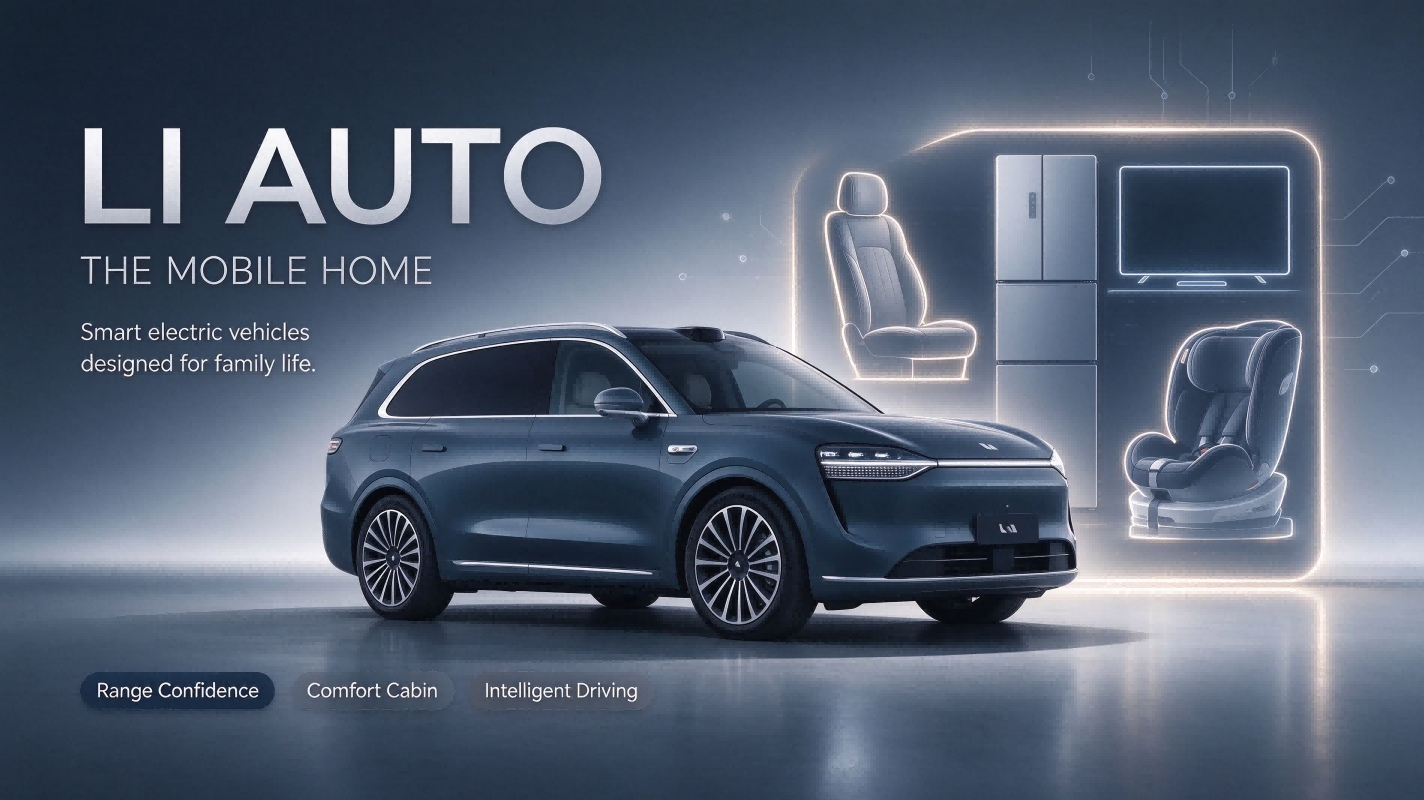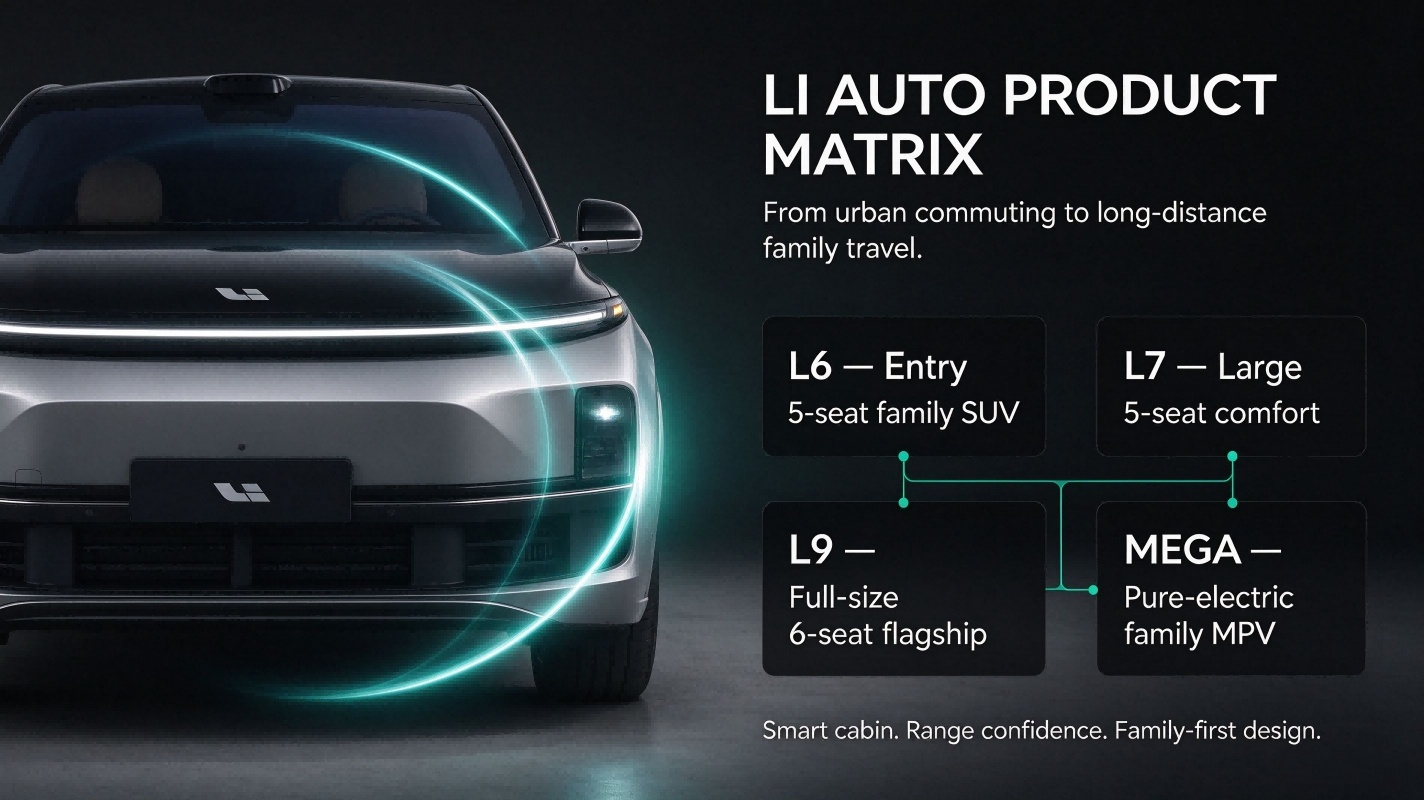
Core positioning: smart electric vehicles for families, "a home on wheels". Product roadmap: range-extended L-series (core volume models) + 800V high-voltage pure-electric i-series + MEGA pure-electric flagship MPV. All models target the family market above RMB 250,000, with clearly segmented product tiers and strong scenario differentiation. The brand features premium comfort cabins, no range anxiety, standard high-end configurations, and in-house developed intelligent driving, making it the most commercially successful player in China’s range-extended EV segment.
I. Product Portfolio Overview (Main Active Models)
(1) L-Series|Range-Extended SUVs (Core Revenue Base)
Shared fundamentals: self-developed 3rd-generation 1.5T four-cylinder range extender, dual-motor four-wheel drive, DC fast-charging compatible battery pack. Electric power for city commuting and gasoline for long-distance trips, free from pure-EV range anxiety. Cabin design family-oriented: multi-screen layout, vehicle refrigerator, ventilated/heated/massage seats, V2L discharge, maternity-grade interior materials, fortress-style body structure. Unified Star Ring light signature delivers high recognition, though criticized for similar styling across the lineup.
1. Li L6|Starting at RMB 249,800, entry-level 5-seat family SUV
· Positioning: 90 sqm two-bedroom home, brand entry model and core volume driver. Rivals AITO M7 and Leapmotor C10.
· Key specs: 2,920 mm wheelbase, 5-seat layout. Standard AWD, CDC suspension and V2L discharge. High trims equipped with Maha M100 chip, LiDAR and urban NOA; no air suspension.
· Strengths: Lowest price entry point, generous standard equipment, well-suited for urban commuting and camping.
· Weaknesses: Limited chassis upper limit; interior texture and sound insulation lag behind L7/L8/L9; 5-seat layout cannot accommodate multi-child families requiring 6 seats.
2. Li L7|RMB 300,000–360,000, mid-large oversized 5-seater
· Positioning: 120 sqm large two-bedroom home, for couples, nuclear families and long-distance road trips / camping.
· Key specs: 3,005 mm wheelbase, class-leading rear legroom; fully flat-folding seats. High trims fitted with Magic Carpet air suspension for premium ride comfort. CLTC pure-electric range 286 km, combined range 1,421 km.
· Strengths: Benchmark comfort among 5-seat models; excellent ride quality with air suspension variant. Ideal for users who do not need 6 seats and prioritize rear passenger space.
· Weaknesses: Oversized body challenging for urban parking; only 5 seats, unsuitable for multi-kid households.
3. Li L8|Starting at RMB 369,800, new-generation flagship 5-seater (revised from previous 6-seat layout)
· Positioning: Premium flagship 5-seat family model.
· Key specs: 72.7 kWh 5C battery, 800V platform, pure-electric range 430 km, combined range 1,670 km. Standard steer-by-wire, rear-wheel steering, dual-chamber dual-valve Magic Carpet air suspension, four zero-gravity seats, Qualcomm 8797 cockpit chip and Maha M100 intelligent driving chip.
· Strengths: Balanced performance in range, charging, chassis and ADAS; supports daily all-electric commuting and long-distance travel. Small turning radius for easy maneuvering despite large dimensions.
· Weaknesses: Removal of 6-seat option loses customers with 6-seat rigid demand; relatively high pricing.
4. Li L9|RMB 459,800–509,800, full-size 6-seat range-extended flagship SUV
· Positioning: 180 sqm three-bedroom home, flagship for large multi-child families.
· Key specs: 2+2+2 6-seat configuration with independent comfortable seats in all three rows. 72.7 kWh 5C battery, pure-electric range 420 km. Full drive-by-wire chassis (steer-by-wire, rear-wheel steering, EMB brake-by-wire). Dual Maha M100 chips with 2,560 TOPS compute power. Four zero-gravity seats, built-in refrigerator and multi-screen entertainment.
· Strengths: Top-tier standard configuration; balanced comfort across all three rows. Technology showcase and halo model of Li Auto.
· Weaknesses: Over 5.2 meters long, difficult for urban driving and parking. Heavy curb weight leads to higher fuel consumption and noise under charge-depleting conditions; high purchase and maintenance cost.
(2) Pure-EV Lineup: MEGA + i-Series (800V 5C High-Voltage Platform)
1. Li MEGA|Starting at RMB 529,800, pure-electric flagship MPV
· Positioning: Premium pure-electric family MPV, mobile penthouse, suitable for large families and business receptions.
· Key specs: 800V / 5C ultra-fast charging, replenishes approx. 500 km range in 11 minutes. 3,300 mm wheelbase, 6 seats, second-row swivel seats for face-to-face seating. Magic Carpet air suspension, superior cabin space and generous trunk volume even with full occupancy.
· Strengths: Completes the brand’s MPV portfolio; ultra-fast charging removes long-distance pure-EV pain points and flexible interior layout.
· Weaknesses: Polarized opinions on bullet-train styling; massive body hard to navigate on narrow roads; high price limits target group.
2. i-Series (i6 / i8)|Pure-EV SUVs
· Positioning: 800V high-voltage pure EVs for family users with stable charging access, complementary to range-extended L-series.
· Key specs: Low-drag design, 5C fast charging, quiet and smooth pure-electric operation. Retains Li Auto’s cabin comfort philosophy including refrigerator, premium seats and unified ADAS system.
· Strengths: Expands pure-EV footprint, captures buyers in well-charged cities who reject range extenders.
· Weaknesses: Reliant on charging infrastructure; less flexible for cross-country trips than range-extended models; lower brand awareness than L-series.
II. Core Logic of Product Strategy
1. Segmented by usage scenarios instead of mere body size The brand adopts a "residential apartment" mental model: L6 entry 5-seater, L7 large 5-seater, L8 premium 5-seater, L9 6-seater for big families, MEGA high-space MPV. Users select models by family size and travel scenarios rather than complex parameters, lowering decision friction.
2. Range extension as the foundation, pure EV as the second growth curve Range extension precisely addresses mainstream family demand: EV-level comfort and intelligence without reliable charging access and for frequent long-distance trips. i-series and MEGA target users in well-developed charging regions who accept pure EVs, enabling dual-track development without single-route betting.
3. High-end features as standard, minimal optional packages A distinctive industry tactic: AWD, ADAS hardware, comfort features (seats, refrigerator, multi-screens) are largely standard. Trim differences focus on high-tier hardware such as ADAS chips, air suspension and drive-by-wire chassis, cutting selection anxiety and strengthening perceived value.
4. Consistent experience: cabin and comfort prioritized All models share identical cabin UI, Li Auto voice assistant, ADAS stack and OTA update logic. The selling point is not acceleration or off-road capability, but family-friendly ride quality, low motion sickness risk and long-haul comfort, precisely targeting family buyers and avoiding head-on competition with performance-focused EV brands.
III. Competitive Advantages
1. Mature and validated range-extended technology: Optimized NVH and fuel consumption for the 3rd-gen range extender with proven service cycles and massive user data accumulation. Range extension is positioned as a practical family energy solution rather than a transitional technology.
2. Strong cabin moat: Ergonomic seating, precise refrigerator temperature control, multi-screen interaction, full-zone voice control, low-VOC interior and V2L camping function form a family-scenario advantage hard for competitors to replicate comprehensively.
3. Steady ADAS iteration with clear hardware pre-installation: Self-developed Maha ADAS chip ecosystem; reliable urban NOA deployment supported by abundant highway and family trip data.
4. Channel & service synergy with products: Retail centers, ultra-charging network and delivery/service sites roll out alongside vehicle launches; MEGA and i-series leverage proprietary ultra-charging stations to maximize fast-charging value.
IV. Weaknesses & Risks
1. Homogenized exterior design: L-series share nearly identical styling, making L6/L7/L8 hard to distinguish; conservative styling struggles to attract young buyers seeking individuality.
2. Portfolio gaps and internal cannibalization: After L8 switched from 6-seat to 5-seat layout, the brand lacks a 6-seat SUV in the RMB 360k–420k bracket. L7 and L8 overlap heavily as premium 5-seaters and compete for the same pool of buyers.
3. Inherent disputes over range-extended powertrain: The range extender is essentially an internal combustion engine, rejected by some buyers. Fuel consumption and noise under charge-depleting conditions remain performance ceilings. Pure-electric i-series launched late with weak brand recognition.
4. Intensified price competition: L6 at the RMB 250k price band faces AITO and Leapmotor competition. L9 and MEGA above RMB 450k compete against Denza, Zeekr and high-end MPVs. Rivals are rapidly catching up on refrigerators, air suspension and ADAS, diluting Li Auto’s comfort advantage.
5. Chassis tier gap: Entry L6 has no air suspension, creating a noticeable ride-quality gap between low and high trims.
V. Competitor Benchmarking
· L6: AITO M7, Leapmotor C10, Voyah FREE
· L7: Denza N8, Xpeng G9, Zeekr 001 (comfort-oriented 5-seat variant)
· L9: AITO M9, Denza N9 SUV, Yangwang U8 family version
· MEGA: Denza D9, Zeekr 009, Volvo EM90
VI. Summary
Li Auto is a typical case of scenario-driven product definition. Instead of chasing extreme performance metrics, it standardizes and delivers all-family ride comfort, zero range anxiety and worry-free intelligent mobility. The range-extended L-series serves as the stable volume backbone, MEGA opens the high-end MPV market, and the i-series completes the pure-EV lineup. Key challenges ahead: sustaining differentiated family comfort positioning, filling the vacant 6-seat SUV segment, boosting recognition of pure-EV models and responding to fast-following competitors.